
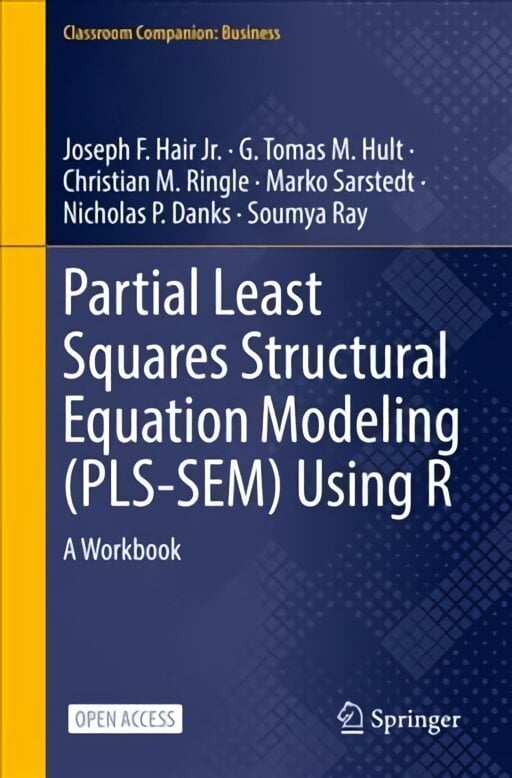


Partial least squares structural equation modeling (PLS-SEM) has become a standard approach for analyzing complex inter-relationships between observed and latent variables. Researchers appreciate the many advantages of PLS-SEM such as the possibility to estimate very complex models and the method’s flexibility in terms of data requirements and measurement specification. This practical open access guide provides a step-by-step treatment of the major choices in analyzing PLS path models using R, a free software environment for statistical computing, which runs on Windows, macOS, and UNIX computer platforms. Adopting the R software’s SEMinR package, which brings a friendly syntax to creating and estimating structural equation models, each chapter offers a concise overview of relevant topics and metrics, followed by an in-depth description of a case study. Simple instructions give readers the „how-tos” of using SEMinR to obtain solutions and document their results. Rules of thumb in every chapter provide guidance on best practices in the application and interpretation of PLS-SEM.
Daugiau prekių iš šios kategorijos
- Introduction to PLS-SEM: Partial least squares structural equation modeling (PLS-SEM) is a widely used method for analyzing complex relationships between observed and latent variables, valued for its ability to estimate intricate models with flexible data and measurement requirements.
What is Partial Least Squares Structural Equation Modeling (PLS-SEM)?
Partial Least Squares Structural Equation Modeling (PLS-SEM) is a widely used analytical method for examining complex relationships between observed and latent variables, offering flexibility in data requirements and model complexity.


