
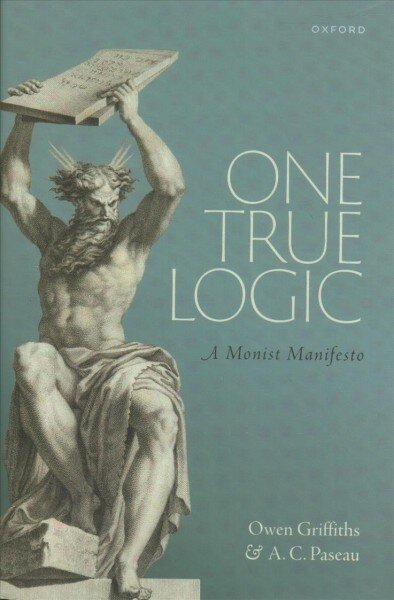


Logical monism is the claim that there is a single correct logic, the ‘one true logic’ of our title. The view has evident appeal, as it reflects assumptions made in ordinary reasoning as well as in mathematics, the sciences, and the law. In all these spheres, we tend to believe that there are determinate facts about the validity of arguments. Despite its evident appeal, however, logical monism must meet two challenges. The first is the challenge from logical pluralism, according to which there is more than one correct logic. The second challenge is to determine which form of logical monism is the correct one. One True Logic is the first monograph to explicitly articulate a version of logical monism and defend it against the first challenge. It provides a critical overview of the monism vs pluralism debate and argues for the former. It also responds to the second challenge by defending a particular monism, based on a highly infinitary logic. It breaks new ground on a number of fronts and unifies disparate discussions in the philosophical and logical literature. In particular, it generalises the Tarski-Sher criterion of logicality, provides a novel defence of this generalisation, offers a clear new argument for the logicality of infinitary logic and replies to recent pluralist arguments.
Daugiau prekių iš šios kategorijos
- Logical Monism and Its Appeal: Logical monism claims there is a single correct logic, reflecting common assumptions in reasoning, mathematics, sciences, and law, where arguments are seen as definitively valid or invalid.
What is logical monism and why is it appealing?
Logical monism is the belief that there is a single correct logic, which aligns with our usual assumptions about the validity of arguments in reasoning, mathematics, sciences, and law, where facts about argument validity are considered determinate.


